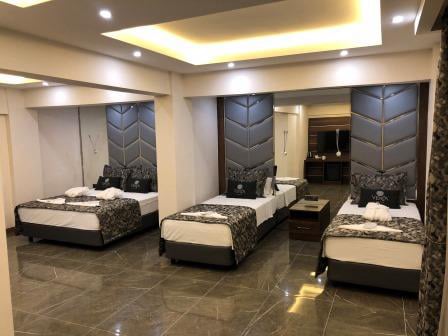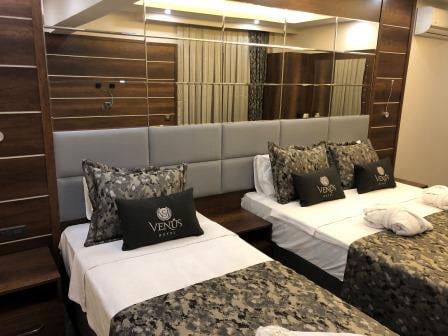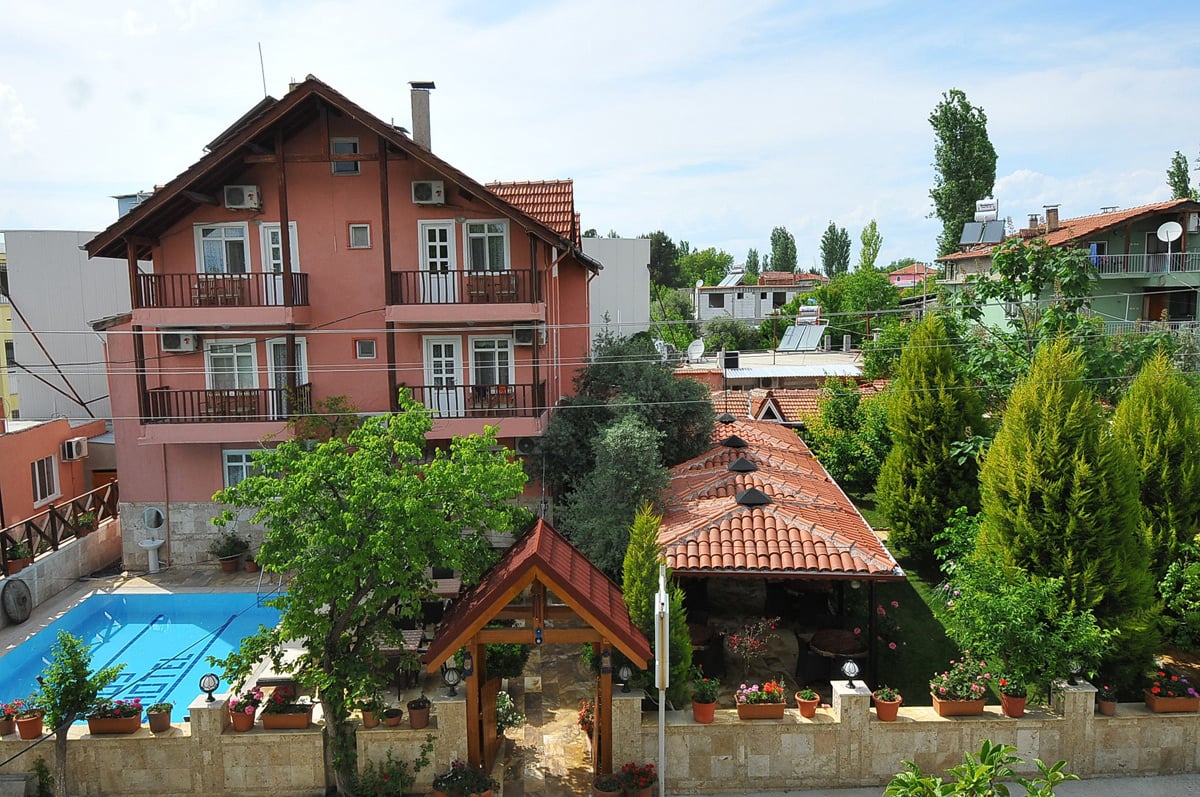
| Venus Hotel is a family run hotel with a charming
home-like atmosphere, located in the pleasant village of Pamukkale.
We have a gardened courtyard, private swimming pool, free internet
access, international phone and fax facilities, free transfer from
bus station and private car parking available.
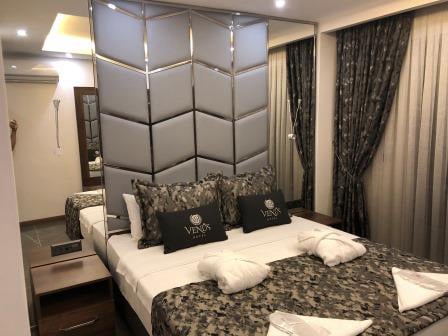
All our rooms have modern bathrooms with
24 hour hot water, are tastefully decorated and have airconditioning
and hairdriers. Two of the floors have rooms with private balconies,
with views of Pamukkale's famous traventines and our tranquil garden-pool
area, or from others you could catch a glimpse of the picturesque
mountains. There is also a comfortable, sunny Ottoman corner, perfect
for peaceful reading or chatting to other backpackers and guests.
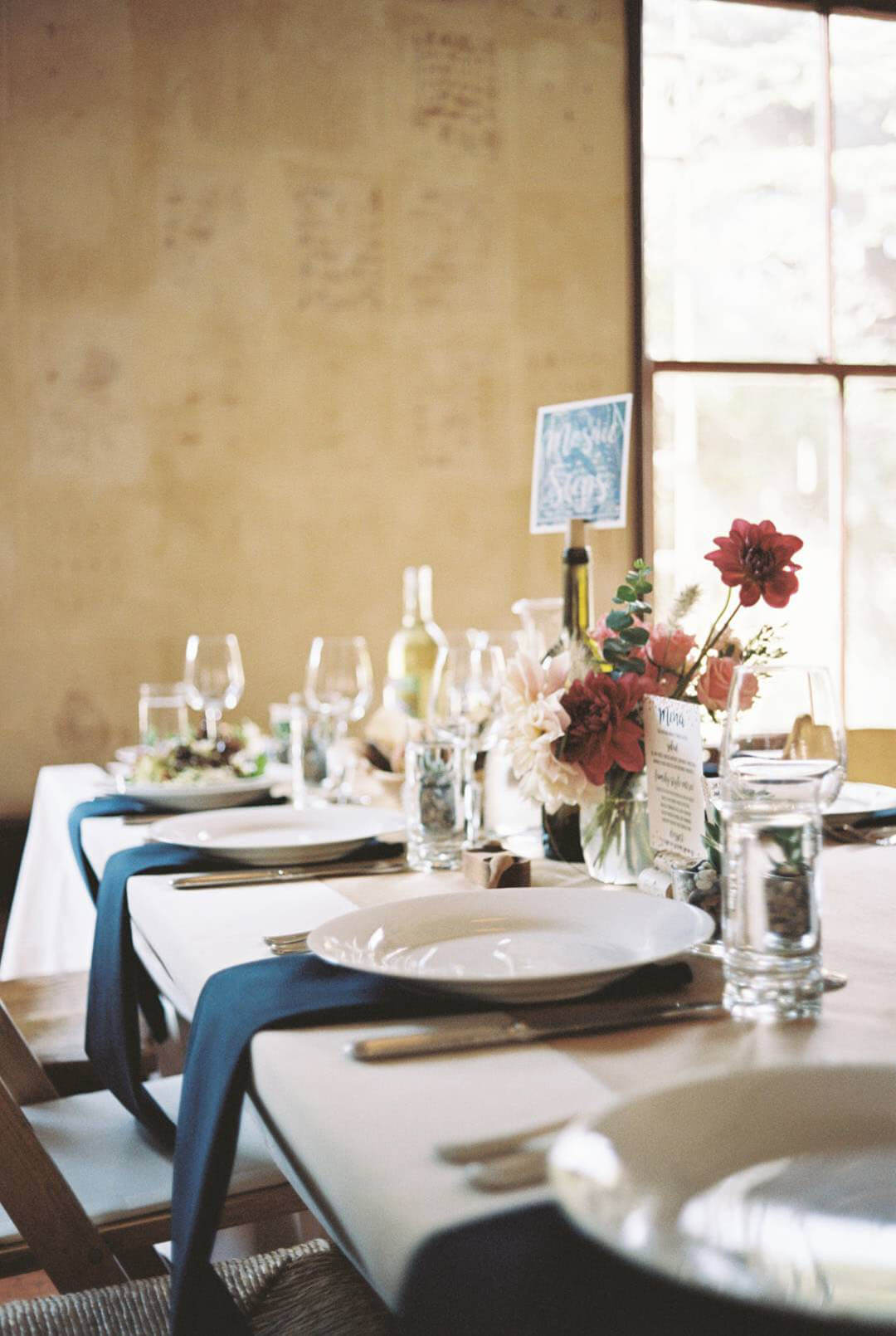
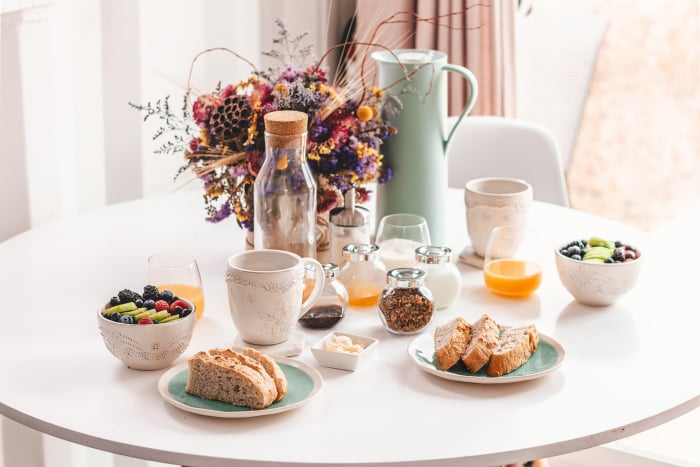
From our popular restaurant, (highly recommended by guests and guide
books!) we provide a large choice of traditional, home cooked meals
with vegetarian options and special kebabs available.
We can easily organise day trips to the many
highlights of the area including Aphrodisias, Laodikya, Kaklik and
Ephesus and have a wealth of extra information on culture, traditions
and other travelling within Turkey from the multi lingual owners.
'Heaven!!!
This was the perfect experience. Everyone needs to go to Turkey
and stay here. the hotel and our room were charming! We had a shower
and a bathtub and the water was hot! The owners are very nice, the
internet is free, and the owner's mother cooks delicious food. '
- a valued guest 2006
The obvious attraction of Pamukkale
is the gleaming calcium travertines which are now a world heritage
site. Pamukkale actually means "Cotton Castle" and it's
easy to see why, with the distinct shape of the travertines. The
terraces are formed by a chemical reaction that results in calcium
carbonate sedimenting to form a travertine. The calcium rich waters
are about 35.6 C when they first come from the ground and flow over
the terraces into the beautiful pools.
Above the travertines there is a Municipal pool and the Roman ruins
of Hierapolis with the biggest necropolis in the world.
There is also e thermal bath above the travertines,
with the spring water's temperature being about 36C. The water is
rich in minerals, is believed to have strong medicinal properties
and is excellent for your general well being. Bring your swimsuit
and enjoy in Pamukkale's therapeutic waters.
In nearby Karahayit, the spring water comes
from the ground at around 56C and is rich in iron. The flow of this
water over the rocks results in the red colouring. Many people come
to admire it's beauty.
Colossae is situated on the hills about 7
km. away from Pamukkale. There is not much remaining of this ancient
city, but you will find some traces of the Roman period theatre
and some foundation constructions can be seen.
This antique city is situated 60 km. away
from Pamukkale. It was first constructed for defense purposes, but
was later reconstructed by the Romans. The Apollo cult was important
in Tripolis. Now days you can see some remmants of the theatre,
city walls and some of the other buildings.
This area was first settled because of these
thermal waters. The city of Hierapolis was established in 190BC
by the king of Pergamon, Eummanes II. The city was very properous
under Roman rule and even more so under the Byzantines.
The Basilica : You will find the Basilica to the east of the big
bath right next to the road. It's thought that it was constructed
after Hierapolis became the centre of the Bishopry. The errection
of Basilicas and churches lead to the city's adoption of the Roman
architectural style.
The Agora : Toward the southern gate, close to the Gymnasium and
big bath you will find the Agora. The bazaar and great meetings
took place here. Insriptions were found during the excavations of
the Agora which indicated the importance of cotton growing and weaving
to the area.
The Colonnaded Street : The Colonnaded street is about 1 km long
and runs through the whole city. In Hierapolis high day, it would
have been lined by stoas and important buildings. At the northern
and southern ends of the street, outside the Byzantium city walls,
you will find momumental gates, which were constructed during the
Roman period.
The Great Bath Complex : Today the great bath houses the museum.
It's thought that the interior of the building was covered in marble.
The construction is typical of Roman Baths.
Saint Philippe Martrium : Saint Philippe Martrium is Octogonal in
shape and was built on the site where it is thought that St Philip
was martyred. Saint Philip was one of the twelve Apostles , he worked
hard to spread Christianity in Hierapolis and together with his
sons, founded the first christian community.
The city is situated 6 km from Pamukkale
and was built in the 3rd centurty by King Antricos II. The city
"Laodicia" was named after his wife Laodicee. Laodicia
is an important site to see, as you will find one of the first seven
churches built during the spread of Christianity. Laodicia's location
was important, as it was stiuated on the road connecting the trading
centres Ephesus and Miletos
Situated 7 km. away from Pamukkale the Akhan
Caravansary is a traditional travellers stop in between trade centres.
When you come into Pamukkale;
The road will go under a large gateway with a sign 'Welcome to Pamukkale'
on it.
About 100 metres after this, there is a road
that turns a little off to the left. Drive down here and there are
signs for the hotel on the left side of the road.
Continue for another 200 metres and there is a white, pink and black
sign on the left side of the road. Turn down here and the hotel
is 50 metres along the street and can be seen from the main road.
From Antalya;
Take the main road through Korkuteli, Cavdir and Acýpayam
into Denizli and turn onto the Ankara road. Follow signs to Pamukkale
from there. It should take about 3 hours.
From Ankara;
Take the main road through Afyon and Cardak to a turnoff just before
you get into Denizli. Turn onto Pamukkale road. It should take about
6 hours.
From Istanbul;
Take the main road through Kutahya then Afyon and Cardak to a turnoff
just before you get into Denizli. Turn onto Pamukkale road. It should
take about 8 – 9 hours.
From Selcuk / Kusadasi / Izmir;
Take the Aydin road through Sultanhisar (stop here to see Nyssa),
Nazili and Buharkent to Denizli. From Denizli turn onto the Ankara
road and follow signs to Pamukkale. It should take about 3 hours.
Note: There is a back road from Saraykoy that appears to be a shortcut,
but can lead onto Karahyit (the next town from Pamukkale.) If this
happens, follow signs to Pamukkale and look for the large white
cliffs of the travertines. There are many signs for the hotel through
the Pamukkale village.
From Fethiye;
Take the road through Kemer, Golhisar and Acýpayam and onto
Denizli. From Denizli turn onto the Ankara road and follow signs
to Pamukkale. It should take about 4 – 5 hours.
From Marmaris;
Take the main road through Mugla and Kale and onto Denizli. From
there turn onto Ankara road and follow signs to Pamukkale. It should
take about 4 hours.
From Bodrum;
Take the road through Yatagan, Mugla and Kale onto Denizli. From
there turn onto Ankara road and follow signs to Pamukkale. It should
take about 4 - 5 hours.
From Konya;
Take the road through Beysehir, Isparta and Dinar onto Denizli.
Before you come into Denizli, there is a turnoff to Pamukkale. It
should take about 6 – 7 hours.
From Goreme/Cappadocia area;
Take the road through Konya, Beysehir, Isparta and Dinar onto Denizli.
Before you come into Denizli, there is a turnoff to Pamukkale. It
should take about 8 – 9 hours.
From Aphrodisias,
Drive through Tavas and take the Antalya road to Denizli. From Denizli
turn onto the Ankara road and follows signs to Pamukkale.
From Pamukkale to Aphrodisias,
Drive towards Denizli and turn onto the Antalya road to Tavas. Follow
signs to Aphrodisias from here. This is the shorter way. Driving
through Nazili will take about 30 minutes longer.
|